Information we wanted to share with our Customers.
How the new pair of heavy-duty diesel engine oil formulations will impact contractors
Friday, July 29, 2016
Wednesday, July 20, 2016
Shared information from our friends at NAPA /2 Stroke vs 4 Stroke: Avoid Ethanol in Small Engines
We found this information to be very helpful and wanted to share with our customers.
Thank you NAPA for quality information.
2 Stroke vs 4 Stroke: Avoid Ethanol in Small Engines
Understanding the differences between 2 stroke vs 4 stroke engines can play an important role in getting maximum performance and lifespan out of your small engines.
The 2 stroke designs are simpler, which means once you introduce additives like ethanol into gasoline it’s much harder to fine-tune the combustion process like you can in a more complex 4 stroke automobile engine. As a result, ethanol does untold damage each and every year to thousands of small engines in chainsaws, lawn mowers and leaf blowers across the country.
Ethanol is a type of alcohol that can be burned as a fuel, and it is often mixed in with traditional gasoline in concentrations typically approaching 10 percent. In some cases, however, particularly in the Midwest, it’s possible to get much more concentrated ethanol mixtures, surpassing 15 percent and even 20 percent. At this level, the amount of ethanol in fuel can have a damaging effect on 2 stroke engine components.
Since the fuel burn is less precise in 2 stroke vs 4 stroke engines and cannot be adjusted via computer controls, ethanol-heavy gasoline can leave significantly more deposits behind inside a cylinder after it is ignited. When acting as a solvent, like any alcohol, ethanol in gasoline also runs the risk of breaking down engine sludge and sending it through the fueling system, where it can clog injectors and ports. That same solvent behavior also attacks plastic and rubber components, causing them to dissolve over time (especially on older engine designs). Finally, ethanol also attracts water, which means ethanol blended fuel can introduce moisture into a engine and lead to corrosion of the metallic surfaces inside the cylinder as well as in fuel lines and the fuel tank.
For more information on 2 stroke vs 4 stroke engine maintenance, chat with a knowledgeable expert at your local NAPA AUTO PARTS store.
Photo courtesy of Freeimages
Fundamentals
At its core, the key design concept of a 2 stroke engine is that the piston only moves up and down once during a power cycle, with the exhaust and the intake steps occurring simultaneously. A 4 stroke engine, however, sends the piston up and down twice during the power cycle in order to split apart the exhaust gas venting and air, and fuel intake process.The 2 stroke designs are simpler, which means once you introduce additives like ethanol into gasoline it’s much harder to fine-tune the combustion process like you can in a more complex 4 stroke automobile engine. As a result, ethanol does untold damage each and every year to thousands of small engines in chainsaws, lawn mowers and leaf blowers across the country.
What Kind Of Damage Does Ethanol Do?
As explained above, 2 stroke vs 4 stroke engines don’t offer the same level of precision when it comes to spark plug firing and air/fuel ratio mixture. These types of engines also require a specific ratio, mixing gasoline and oil together in order to stay properly lubricated.Ethanol is a type of alcohol that can be burned as a fuel, and it is often mixed in with traditional gasoline in concentrations typically approaching 10 percent. In some cases, however, particularly in the Midwest, it’s possible to get much more concentrated ethanol mixtures, surpassing 15 percent and even 20 percent. At this level, the amount of ethanol in fuel can have a damaging effect on 2 stroke engine components.
Since the fuel burn is less precise in 2 stroke vs 4 stroke engines and cannot be adjusted via computer controls, ethanol-heavy gasoline can leave significantly more deposits behind inside a cylinder after it is ignited. When acting as a solvent, like any alcohol, ethanol in gasoline also runs the risk of breaking down engine sludge and sending it through the fueling system, where it can clog injectors and ports. That same solvent behavior also attacks plastic and rubber components, causing them to dissolve over time (especially on older engine designs). Finally, ethanol also attracts water, which means ethanol blended fuel can introduce moisture into a engine and lead to corrosion of the metallic surfaces inside the cylinder as well as in fuel lines and the fuel tank.
How Can You Avoid Ethanol Damage?
The easiest way to prevent ethanol damage is to simply avoid gasoline that contains an ethanol mixture. Always check at the pump to make sure that the fuel you are using is ethanol-free, or at the very least, contains 10 percent ethanol or less (the maximum safe ratio for newer 2 stroke engines). If you can’t find ethanol-free fuel at your local gas station, then you can always check your local NAPA Auto Parts store for a canister of ethanol-free, pre-mixed small engine fuel.For more information on 2 stroke vs 4 stroke engine maintenance, chat with a knowledgeable expert at your local NAPA AUTO PARTS store.
Photo courtesy of Freeimages
Friday, July 8, 2016
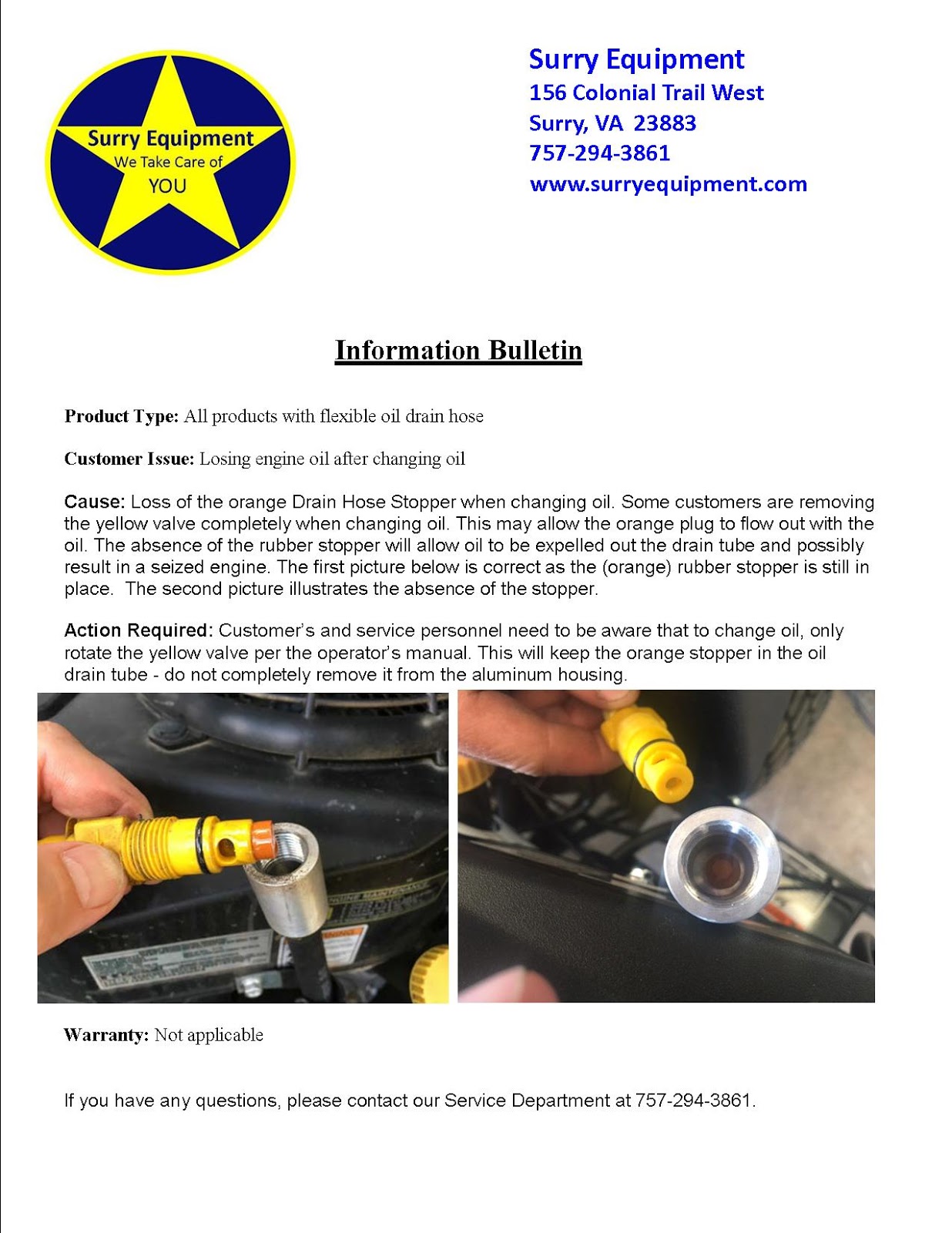
All Products with flexible oil drain hose. Information Bulletin
We are providing this information to our valued customers.
We are getting some customers with questions on the correct way to change
the oil, or issues of oil loss after change. Hope this helps.
Friday, November 20, 2015
Winter will be here before you know it. ARE YOU READY?
With winter weather closing in, the last thing you want to
think about is being stranded on the side of the road. There are things you can
do now to avoid car related trouble down the road.
Here are three steps to ready your car for winter:
1. Check the battery. When the weather gets cold, your
battery will face additional strain. When was the last time you had your
battery and charging system checked? Don’t overlook the importance of this
step. Bring it in to one of our
Technicians at Surry Equipment and we will take care of it for you.
2. Flush and add new antifreeze. If you did this within the
past 12 months, you don’t have to do so again. However, if you can’t remember
the last time your antifreeze was changed, schedule an appointment for this to
be completed at Surry Equipment.
3. Inspect your tires. The winter months can bring quite a
bit of precipitation, including rain,
sleet, ice, and snow. It is imperative that your tires are in condition to deal
with every type of road condition.
Tip: in addition to inspecting tire tread depth, your tire
pressure should be checked every week or so.
Just the same as fall driving, there are dangers associated
with hitting the road during the winter months.
Now is the time to ready your car for winter. You don’t want
to wait until it is too late!
Check out our Winter Maintenance Special Running now!

Contact Justin or Herb to make your Appointment today.
757-294-3861
Hope everyone has a safe Winter Season.
Tuesday, September 22, 2015
We Sell The Best and Service The
Rest!
We here at Surry Equipment are
proud of our many product lines and we stand behind them 100
percent. For every product we sell, there is a certified mechanic to
service it. Even if we don't sell it, we can service it. Even the latest
Computer Controlled Tractors.We perform State Inspections and vehicle maintenance. While Getting your car serviced we are now doing a 30 point courtesy check on all vehicle’s. The service department has special offers on brake services, tire change specials, air conditioning recharge packages, and so much more. Offering Front End Alignments on our New State of the Art Alignment Machine. Give Jack a call and set up your appointment today.
We also have an extensive stock of parts and accessories to choose from. With thousands of parts in stock, we are bound to have what you are looking for and if we don't, we can get it quickly.


Thursday, April 16, 2015
Equipment Sales
We would like to thank our Loyal Customers. Has been a productive week for our New Holland sales department. David has been busy, we sold two Boomer 24 Tractors w/ Loaders, and one Workmaster 40. Again we would like to thank our customers for their continued support. Don't for get to check out the specials we have running on our website, www.surryequipment.com

Friday, March 6, 2015
What tractor is this?
We get a lot of calls from people that are unsure about exactly what tractor they have. I will try to help out with some basic info and hopefully follow up with more in-depth info later. The first question is who made your tractor? This confusion comes from the similarity of older Ford and Ferguson tractors. Ford “borrowed” the 3 point hitch system from Ferguson and some Ford tractors actually say “The Ferguson System” on them. However- when it comes to parts Ford is NOT the same as Ferguson. So- first of all find the name on the tractor. Now here's some info to narrow that down- We like to ask everyone “ How do you put gas in it?” There are 3 likely answers that really have to do with the hood. 1- I open a little door in the hood that opens from the front to put gas in- that's an N series. 2- The hood opens from the side and I put gas in. That's a 53-64. 3-I don't open the hood the filler neck is in the cowl/panel. That's a 65 up. That usually gets us in the ballpark to get the correct parts. OK now N-series breakdown. The first thing to remember is these tractors were built a long time ago. Many a swap could have been done over the years because it all pretty much swaps back and forth. You really can't do anything about the past so here are some guidelines: If it is a 3 speed transmission it is a 2N or 9N, 4 speed is a 8N. If it has a small bolt circle on the front wheels- about 6 inches it is a 8N, bigger- about 12 inches means 2N, 9N. The radius rod which is the long arm that runs from about your foot to the front axle I beam style- pre 1944, oval tube- after 1944. Crazy looking impossible to get to front distributor- 1939-1950. More normal looking side mount distributor- 1950-1952. OK- gotta run to the Big City. I will be back with more of "Name that Tractor" later. Thanks Charles
Subscribe to:
Posts (Atom)